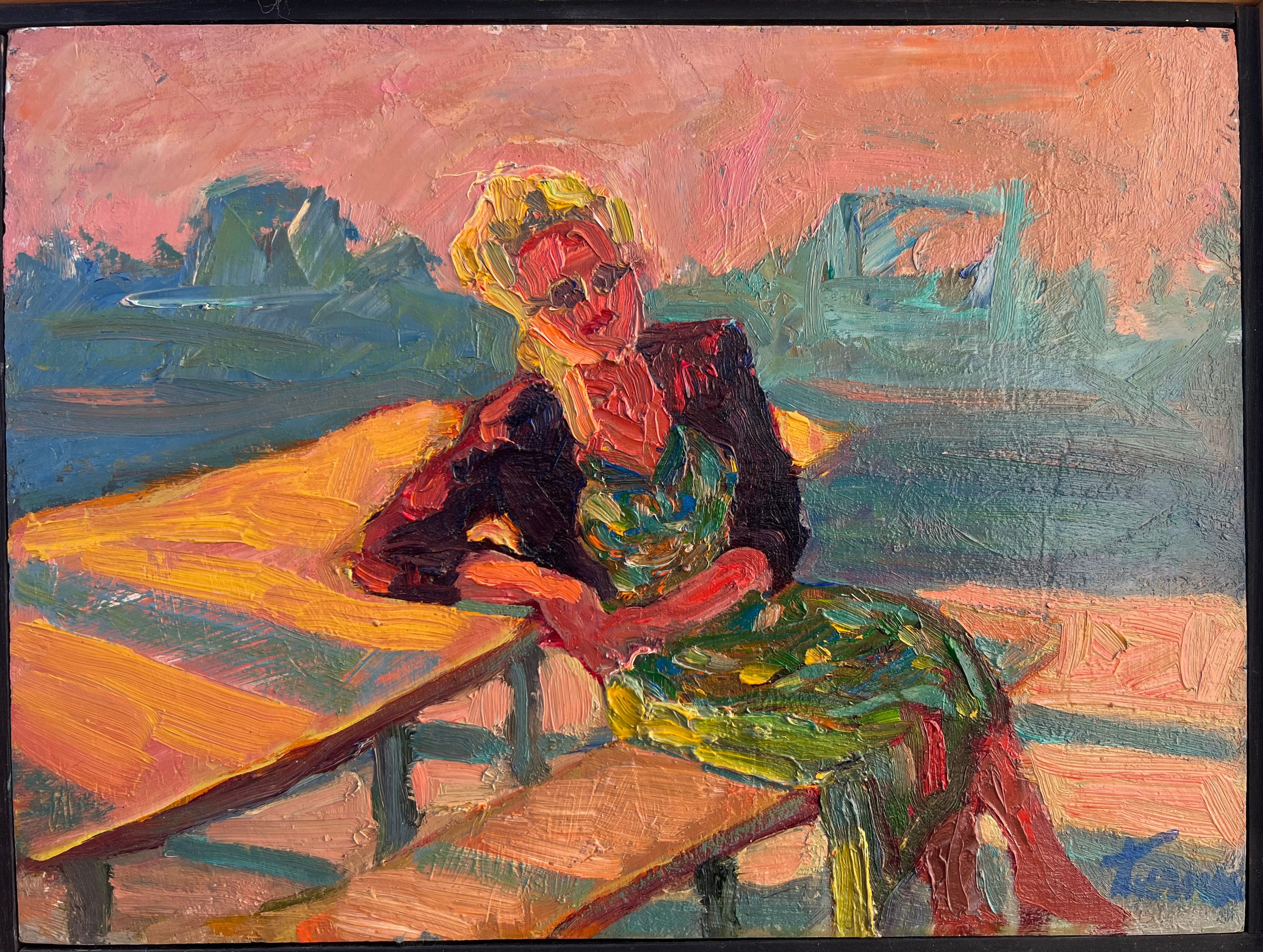
Sometimes it seems that all roads lead to Benicia. Was invited to join a tour of the di Rosa Preserve near Napa Friday, located off Hwy 12 in Carneros. You may have seen the sheep lined up on a hill. They were moved to a pasture and replaced by a dramatic orange steel sculpture by international artist Mark di Suvero to draw attention to the entrance. This is Rene di Rosa’s life’s work, a combination art park and nature preserve, a stone house on 250 acres of hilly grasslands, meadows, a lake, some of the finest pinot noir grape vineyards in the world, and the largest collection of Northern California art anywhere.
Docent extraordinaire Sharon Coker began our tour standing by the windswept lake in the shadow of what is now the event center. Shortly, an open-air jitney transported us up the hill to Gallery 2 where the art collection now resides.
Had visited before when Rene di Rosa was alive and toured his old stone house, literally filled to the rafters with art. There were paintings on the ceilings and in the bathtub. It got so crowded that he eventually had to move to an apartment over the garage. To say he was an avid collector is an understatement. Rene was a self-described art addict, spending decades befriending artists and visiting their studios. He was also parsimonious, and bargained an artist down until he got what he wanted. He was known to dress as a poor farmer at various open studios to conceal his identity and discourage price hikes.
He eventually sold off part of the land to Seagrams and Constellation so that he could buy more art.
Where does Benicia come in? He owned more works of local ceramicist Robert Arneson than just about any other artist. His collection was dominated by the likes of former Benician Manuel Neri, Port Costan Roy de Forest, and William Wiley who taught at UC Davis during the heyday of the Funk Art Movement.
.
About Rene and the Collection
Growing up on the East Coast with an heiress mother and an Italian diplomat father, he attended Yale and then decamped to Paris to write the Great American Novel. Distracted by a French ballerina whom he married and having served in WWII, he returned to the US and got a job at the SF Chronicle. He soon tired of deadlines and settled on the idea of becoming a wine grape grower. The 500 acres of land that he acquired became the di Rosa Preserve.
Knowing nothing about farming, he enrolled at UC Davis at an auspicious time. The School of Viticulture and Enology was next door to the now famous art department in TB-9. Bored with his botany courses, he began hanging out with the art students and buying their work, in time becoming their most prolific collector.
His sensibilities were a perfect match with the students who rejected the sophistication and snobbishness of the NY School of Abstract Expressionism. “What matters to me is what it’s made into, not what it’s made out of. Multimedia. Chewing gum, crab claws, hair, bones, bowling balls, feathers, marbles, brooms, boots and shoes, shirts. Paint is nice, too,” Rene said. See catalogue: “Local Color: The De Rosa Collection of Contemporary California Art,” available at their bookstore.
As we toured the collection in Gallery 2, we noticed that there were no labels on the walls. According to Rene, “Words can and do get in the way. Wall labels do not reveal the work and can be insistent distractions. When you walk into a museum and see all that blah blah on the wall, the subtext seems to be ‘You can’t negotiate this without our help.’ He held the same disdain for critics. Bill (William) Wiley once said of his own work, ‘Just because I made this stuff doesn’t mean I know any more about it than you do.’ ” See catalogue above.
A fairly new addition is an installation in the basement of the stone house called “Chartres Bleu,” an interpretation of the blue stained glass windows of Chartres Cathedral outside Paris. Artist Paul Cos was transfixed by how the light was continually changing the colorful biblical scenes depicted in the 13th Century windows. We sat there quietly watching the transformation and feeling the peace and sacredness of the simple concrete space. The windows looked somewhat distorted and blurry, but I was wearing an old pair of glasses.
“Are they stained glass?” I asked. “They are actually old TV monitors stacked one on top of another, each one depicting an image from the original at Chartres and plugged in from the back,” Sharon said. Murmurs all around. “They are designed so that the light changes behind the glass in increments of 12 minutes, representing 24 hours in a day.” Talk about “fooling the eye.” This gives new meaning to the term “tromp d’oeil.”
After eating our bag lunches on picnic tables set in a copse of trees overlooking the sculpture meadow, we wandered down into a fantasyland of monumental outdoor art — pyramids, immense wheels, a steel dragon, and more. Became dizzy looking up at the world’s tallest file cabinet — seven stories of black file cabinets stacked one on top of another. Sculptor Samuel Yates crushed and shredded an MG Midget convertible, weighed the pieces and dispersed them in the black metal cabinets’ drawers — heaviest at the bottom, to discourage tipping over. Wondered if anybody had tried to climb it using the drawer pulls as a ladder. Birds vied for the view from the top, the best in the Valley.
The 2017 Napa fire almost destroyed the property. Rene had passed away in 2010. Most of the art in the home suffered smoke damage, although much of it has been restored. Since then the Preserve has struggled financially and is now for sale.
“We are hoping to find a partner who will buy the land so we can rent back the space and keep the museum going,” Sharon said. “ The asking price seems very reasonable — $11 million — considering the location and access to the largest trove of Northern Cal regional art in the world.” They are currently in negotiations with the Land Trust of Napa County. Keep your fingers crossed. This collection is a rare treasure worth keeping.

