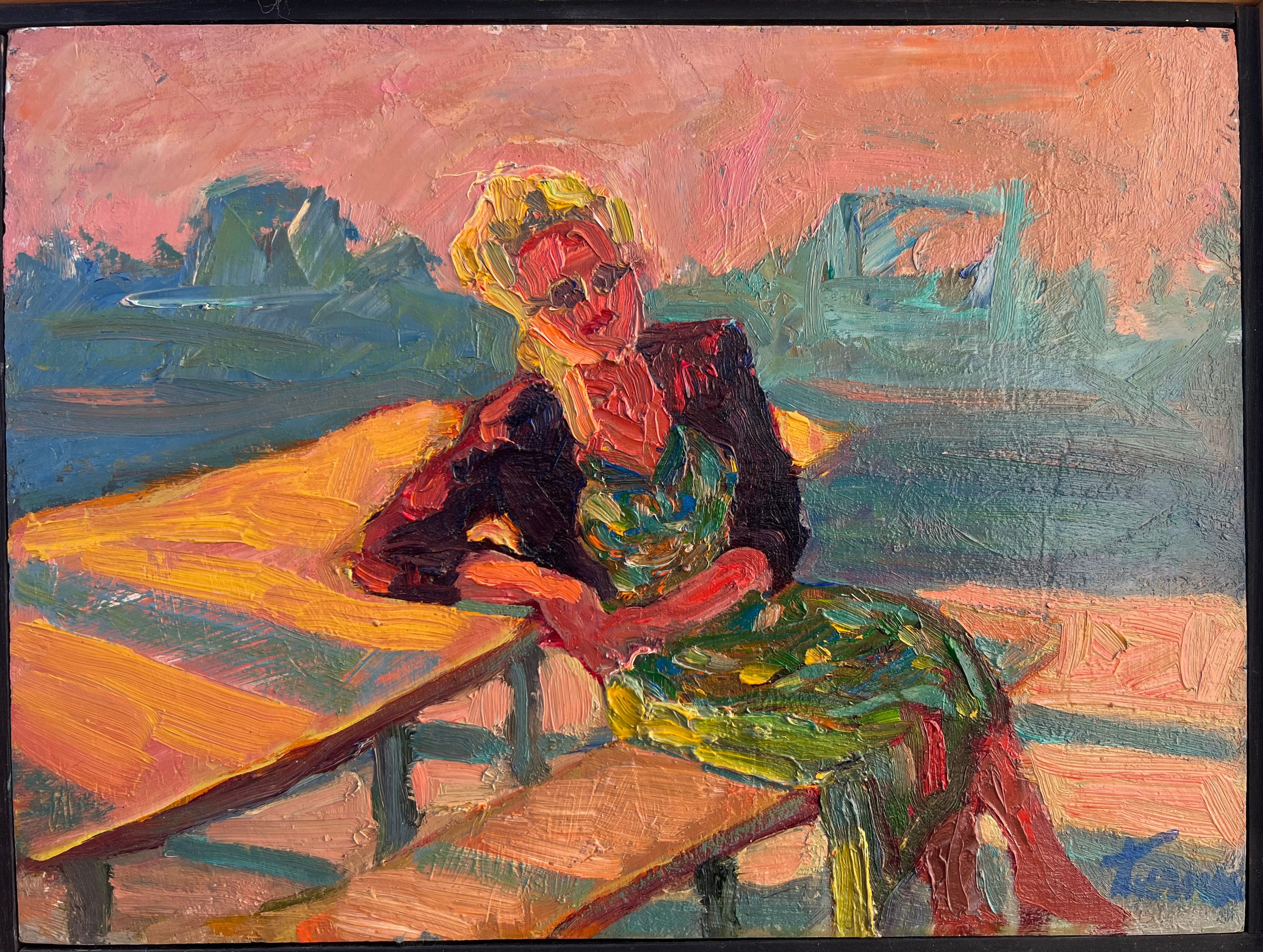
While meandering down First St. I am reminded of the old Buddhist trope that everything and everybody is connected. Painter Jerrold Turner who passed away at age 92 on Valentine’s Day is an example of how this works. He may not have been widely known outside the Bay Area’s fine art community, but his influence is just about everywhere you look in downtown Benicia.
Jerry or Turnosso as I called him, lived in a modest downtown house that he fashioned to look like a southwest adobe — Talavera tiles embedded in the plaster along with some of his paintings. Walking through an arch, you entered a sunny patio. Behind the brightly painted from door was a large room which served as a home, studio, office, and gallery — one open space with the walls lined floor to ceiling with dozens of yummy, shimmering, vibrant paintings. You couldn’t tear your eyes away.
Depending on who you talk to, Turner he was many things: friend, mentor, teacher, rascal, jokester, lover of women, genius, outrageous, and he “didn’t give a rat’s ass.” He had a twinkle in his eye and liked to shock. “He was funny and generous and full of juice,” said artist Dixie Mohan, “and also quite spiritual, but not in a religious way.” “Another legend is gone,” artist Nikki Basch Davis wrote in an email the day he died.
Beginnings
Nikki met him in 1972 in an art class in Walnut Creek. “He was a beginner, and his work wasn’t great,” she told me. They would go out and paint and found a chicken coop that they used as a studio. His life changed in 1983 when he saw a show of the “Society of Six” at the Lesher Center for the Arts in Walnut Creek. “You’ve gotta see this show,” he told Nikki. “This is it. This is the way I want to paint!” he exclaimed. He had found his muse.
Over the years, she and Jerry scouted painted locations, pulled out their easels from the back of Turner’s funky red pickup truck, and got to work. China Camp, Rodeo, Crockett, Port Costa, and Benicia were favorites. You can often spot the red truck in his earlier paintings. Others joined them. Turner sought out Pam Glover, Lundy Siegriest — son of Society of Six member Louis Siegriest — Bill Rushton, and Terry
St. John to paint with. They were recreating the same camaraderie as “The Six” did back in the early part of the 20th Century, using vibrant color and quick brushwork to capture a scene. What was it about his work that inspired others? “He is the master of his use of dark colors. To know happiness one much know sadness … darkness brings light. So I find his work timeless,” said painter Sue Wilson.
“He is, perhaps, not as famous, but is in the same rank of fine artists as any of the Bay Area Figurative School and has all of the attributes of more well-known painters, including the Society of Six,” Susan Johnson said. “I have several that I look at every single day, and I always find new things to appreciate. He had a genius for selecting colors — sometimes surprising.”My First Siting
I first saw his work back at Epperson Gallery in the late 1990s when it was called Designs in Crockett and instantly fell in love with the work. It reminded me of the French Fauves — luscious, brilliant color, bold brushwork, sketch-like and not highly finished. An art history major, I was inspired to see more, to study, collect, promote, and write about it. Along with a Crockett-based environmental group, we organized “Scene on the Strait,” where Turner and Nikki and a dozen artists worked with us to produce the first major paintout in the area in Martinez. It was a lot of work and so much fun. My sister Janie and brother in law Tom would fly in from Flagstaff every year to help set up and work the show and became avid collectors of Turner and other California plein air painters.
About the same time, I started publishing “The Plein Air Scene,” a paper newsletter reporting on artists, shows, paintouts, and the art history of the movement. This was before the internet, scanners, and other technology and was very labor intensive. I loved talking to artists, gallery owners, going to shows and writing about them and started doing studio visits, driving my Toyota van filled with art collectors all over the Bay Area, I created a class on the history of plein air painting and taught at Orinda Community Center and UC Davis Extension. After seven years, it all became too much, and I stopped publishing but continued to follow the increasingly popular movement of outdoor painting.
My sister Susan Johnson started painting when Turner offered her a brush and paint at one of my Easter parties. She took to it immediately. A natural colorist, she became a member of both Da Group and the Plein Air Gallery and also an eager collector.
In 2003 Jerry formalized his band of painters that been joining him on weekend jaunts to form Da Group. Starting with just a handful of artists, it eventually grew to around 200 people when it disbanded in 2024. This was a very fertile period when plein air painting took off in popularity, with groups popping up all over the country, holding paintouts, festivals, museum shows, and quickdraw competitions. A magazine was born and is still publishing.
Painter Sue Wilson took over the organizational side of the effort and was indispensable to Da Group’s success. “I called him the Pied Piper because artists would come running only if Jerry had chimed in that he was going out on a particular day.” See Wilson’s pleinairlinks.com for a very complete collection of color images, two books on Turner and one on Da Group which she published, artist websites, photos, and 50 videos on Da Group’s You Tube Channel.
First Street Connections
Da Group had been painting for about five years when in 2009 house mover Phil Joy approached Nikki and asked if she wanted to hang some paintings in his vintage bungalow on First Street, now next to Fox and Fawn Bakehouse. By this this time members of DaGroup dreamed of having their own place to show. Turner, Nikki and other painters formed the Plein Air Gallery, a coop that is still going strong today. Some of the best plein air painters in Northern California rotate as members, holding monthly shows and taking turns minding the gallery. This year they will bring back their week-long paintout with a show to coincide with Benicia Art Week June 6. beniciapleinair.com
Further up the street next to One House Bakery is Gallery 621 founded in 2011 by former Benicia artist Pam Dixon to showcase contemporary art. This is where Turner started showing works painted in the last years of his career, a total shift from his plein air landscapes — fantasy, surrealistic paintings based on his imagination, dreams, spiritual musings, and often very funny. Releasing his inner child he would say, “Some are a little raunchy.” Giant fried eggs floating above a beach, a bear having tea at a cafe, a cave painting with aliens riding on the backs of bulls are some examples of this surprising oeuvre. gallery621.comA few doors up from the Plein Air gallery in the Washington House is First Street Arts, formerly HQ Gallery founded in 2015. “Turner was front of mind when we opened HQ,” said Susan Street, plein air artist and activist. “We had our origins in the Plein Air Gallery but morphed into other mediums and styles. Everybody in the gallery was influenced in one way or the other by Jerry Turner.” In it’s latest iteration, HQ has changed its name to First Street Arts, acquired a nonprofit status, and expanded it’s mission as an art hub offering shows, talks, workshops, etc. firststreetarts.com
A block up the street next to Avant Garden is Blackbird Gallery which opened in January 2026. Benicia artists Jean Purnell and Angela White took on the space to show a diverse array of traditional and contemporary fine art. Jean is a long-time collector of Turner’s work and primarily a plein a painter. As a former member of Gallery 621 she authored two books on his later paintings, created mostly during the Pandemic. Go to blurb.com to see some to see some outrageous images from “Jerrold Turner: Fantasy Works” and “Jerrold Turner: Latest Works.” blackbirdgallery.net
A favorite subject matter for plein air painters on First St. is Phil Joy’s boat yard, a collection of rusty, partially submerged boats, floats, cranes, and other detritus. You either love it or hate it. The painters have protected this picturesque scene as it has become a favorite subject. As controversy swirled, they successfully lobbied the city or keep it intact. Phil Joy’s boat yard has become part of Benicia’s art history. Connections, relationships, influences, links, generosity, fun, and passion, Jerrold Turner’s life illustrates how one person with a little help from his friends can create a movement and bring joy to so many.
Thank you Turnosso.

