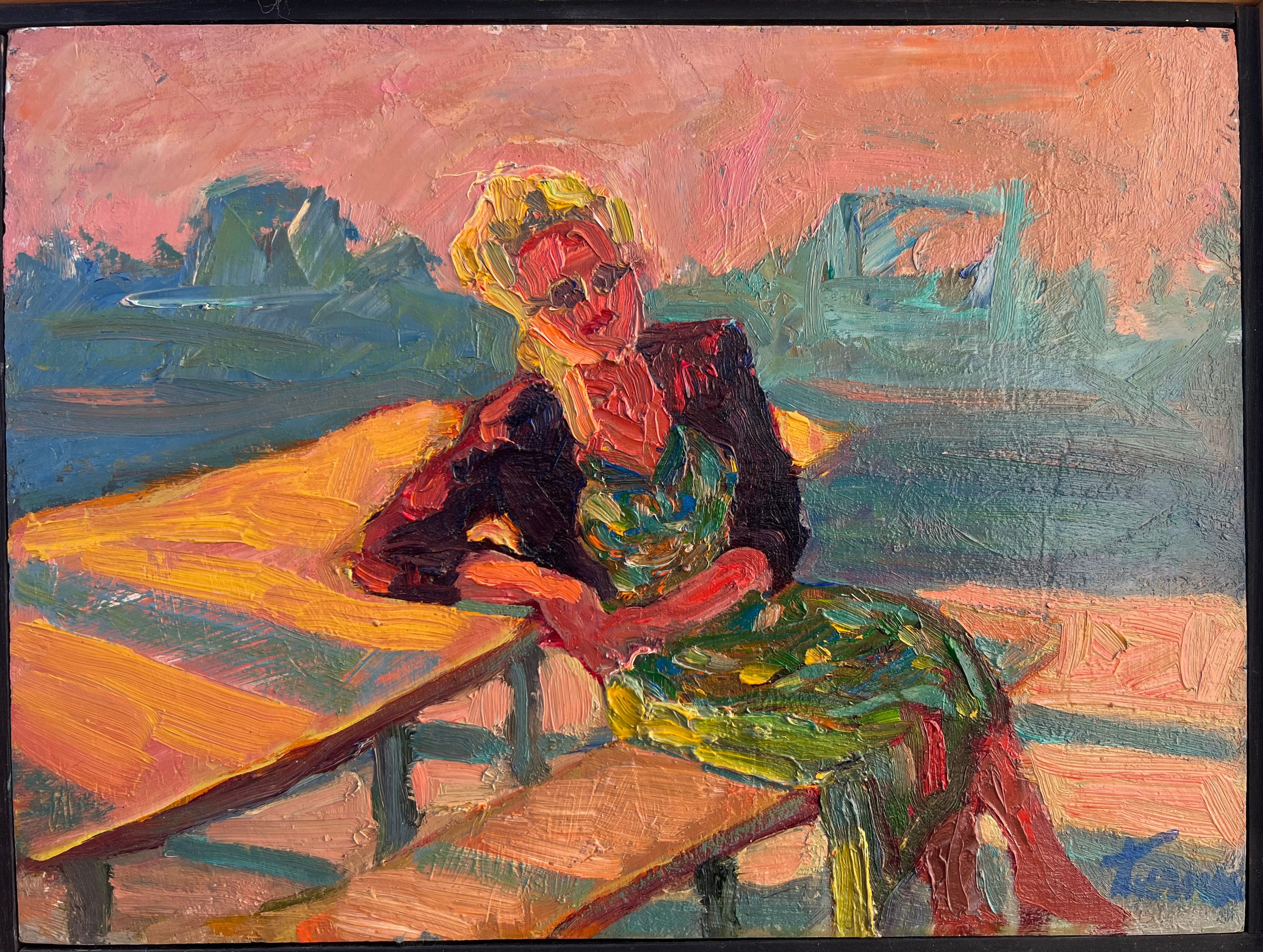
My friend Elizabeth said I must see Art Benicia’s show of Lionel Dalton’s drawings and paintings before it closed. Had visited his frame studio on First St. for years, delighting in his genius in crafting the perfect frame.
“I never knew he was a fine artist,” I said. “Yes, he wasn’t interested in marketing himself and made art mainly for his own enjoyment,” Lionel’s widow, painter Carol Dalton, said
“I was in a drawing class with him for years,” said Marilyn Bardet who wrote a tribute to Lionel for the exhibit. His simply drawn nudes with tea colored washes reminded me of Matisse. Was particularly taken by a wall of self portrait sketches and masterfully drawn hands. Tried drawing a self portrait when I got home. Pulled up FaceTime and studied my face as I scribbled out a quick sketch. It even looked a bit like me, but much older.
Just finished six weeks of classes through UC Berkeley’s Osher Lifelong Learning Institute (OLLI) which has influenced me to look at more art The course, “Five Artists Who Changed California Art,” featured Wayne Thiebaud, Robert Arneson, Manuel Neri, Roy DeForest, and William Wiley. As we know, two of the five (Arneson and Neri) lived and worked in Benicia — De Forest in Port Costa. The class centered on the 1960s and ’70s when all five taught at UC Davis, creating the conditions for an artistic revolution.
Riding the Vallejo ferry munching gluten free muffins, my friend Marialee and I approached the Ferry Building. We hopped on a vintage art deco tram and headed up Market to the SFMOMA. I had ridden one like it back in the late ‘60s in Lisbon when the fare was three cents. It’s more now.
We caught the tail end of the Amy Sherald exhibit, “American Sublime,” a blockbuster show of monumental portraits of African Americans in everyday life. Her painting of Michelle Obama had a room of its own. Sherald depicts a wide range of individuals who she meets on the streets— young, old, gay, trans — in full body poses staring directly at the viewer. Her use of vibrant color, simplified backgrounds, and decorative patterns, contrast with gray monochromatic skin tones, deemphasizing race. Couldn’t help but wonder whether the recent Executive Order 14168, “Defending Women from Gender Ideology Extremism and Restoring Biological Truth to the Federal Government,” would have a chilling effect on such depictions going forward.
Two days later another ferry ride and walk to Berggruen Gallery which had just opened a Bay Area Figurative show. Manuel Neri is often identified as part of that school. It was the day before the official opening so there were no labels next to the paintings. So fun to guess who painted what — Elmer Bischoff, Richard Diebenkorn, David Park. A larger than life-size Neri nude stood in the corner swaddled in cardboard and tape, her arms on her head, straining to get out of a shipping crate.
Gallery Director Melanie Ross recommended another Bay Area Figurative show at Paul Thiebaud Gallery over in North Beach— Paul Wonner and Theophilus Brown. A Neri plaster figure greeted us by the front door. More Benicia connections.
Back in town Saturday for brunch with friends Fran and Karen, we sat on the flower bedecked patio at Cafe at the Inn. My oat milk latte had a design on top (cinnamon?) which looked like a cat’s paw. I showed it to Fran who said he saw the face of Jesus. Art is so subjective.
I was regaled by tales of Karen’s father who had OCD, a focused and precise fellow. “So, he bought one of those ’10,000 Flushes’ to see if it was true,” Fran said. “Well, was it?” I asked. “Didn’t even, come close. He had a little tablet and pencil next to the toilet to mark down each flush.” False advertising.
Had just seen Surrealist artist Marcel Duchamp’s replica of his infamous urinal after the Sherald show at SFMOMA — originally shown in 1917 at the Salon des Independants in Paris. Was Karen’s Dad an artist? What an idea for a conceptual art installation! But the water bill would be horrendous.
Later. Were those donuts in the window of Benicia Art Glass Gallery? Minutes earlier had bought cupcakes at Fox and Fawn Bakehouse. There was a tea tray filled with gorgeous glass dunkers sprinkled with chocolate bits and confetti sprinkles. Wayne Thiebaud! Next to the tray was a life-sized “Bacon Western Hamburger” — all colored glass with tomatoes, cheese, and onion spilling out with a side of glass fries.
“He must have known Arneson’s student Funk artist David Gilhooly of ceramic frog burger fame,” I mused. Two glass hot dogs, adorned with onions and mustard rested nearby in their buns. Another Thiebaud influence, or Arneson, or Gilhooly or all three — or maybe Char’s Hotdogs down the street?
Turns out that the artist, Peter Stucky, grew up surrounded by Gilhooly’s ceramics. His mother was an art collector. Peter, co-owner of Benicia Art Glass Gallery along with Dana Rottler and Nicholas Nouret, studied glass blowing at the California College of Arts and Crafts where he pushed the boundaries of traditional glassware. He is clearly passionate about his art, a playful spirit evident in the totem outside the gallery and the giant sunflower bordering the patio.
Next door at the Plein Air Gallery artist Suzanne D’Arcy was writing up a sale. I told her about the class I took with the UC Davis artists. “I was getting my undergraduate in studio art at UC Davis when they all were there,” she said. More connections.
Outside, I was startled to see a snarling rubber dinosaur head on the sidewalk. Was it art or had a kid dropped his baby dino? Duchamp once said, “The artist performs only one part of the creative process. The onlooker completes it, and it is the onlooker who has the last word.” Okay. Let’s call it art — a “readymade.” It was a fine-looking reptile.

